By Julia Novitch — ‘Berlin is so flat’, Rosmarie Tissi tells me over the phone, from her apartment on a hillside overlooking Lake Zurich. Biking in Berlin, I appreciate its flatness. Designing, I share her lament: there are no vistas. Only the Television Tower marks the skyline – a dotted ‘i’.
Form, feature, dimensionality: topography is important to Tissi; typography, too. The two words stitch together her remarkable seven-decade design career, during which she has travelled to nearly seventy countries. She has produced a vast body of work: logotypes and mailing suites; advertisements and packaging; magazine covers, books, and posters; a series of banknotes, a pair of jeans, a coffee cup, a watch face, and a kite; typefaces – a dozen. Her work has been exhibited and collected internationally. She has received numerous awards and toured the world for juries, workshops, and lectures. Since 1974, she has been a member of the Alliance Graphique Internationale (AGI).
Front cover of a direct mail folder for printing firm Anton Schöb, Zurich, 1980. Tissi’s typographic montage showcases the printer’s range of services – including ‘FOTOSATZ’ (‘phototypesetting’) – to an insider audience of art directors and designers.
I first came across Tissi’s work in 2011, as a design student, while browsing Meggs’ History of Graphic Design. Glyphs wash onto a golden beach, variously rotated and scaled, overlapping and interlocking. No instructions for assembly are given; the pile is a puzzle, and puzzling is a game of pattern recognition – of memory and probability.
Back cover of another direct mail folder for Schöb, 1982. Selected by the New York Type Directors Club for its international exhibition, this work remains one of Tissi’s most widely reproduced designs.
‘I really like letters’, Tissi says of this particular work, an advertisement for a printing firm. ‘They are like pictures’.1 Her characters form a strange kind of skyline – multidimensional, more assemblage than collage. They can be read semantically as well as panoramically: letterforms as landforms, typography as topography. Surveying this landscape reveals the word ‘OFFSET’, a printing method listed among the firm’s services. As a noun, it solves Tissi’s puzzle. As a verb, it deciphers her design practice: to offset is to displace, to purposefully misalign or counteract; perhaps it decodes the larger visual tension Tissi creates between order and disorder, functionalism and expressiveness.
Betweenness is not only a methodology for Tissi, but a lived experience. She is a traveller between geographical regions, spending long periods of time away from Zurich, and between design movements, navigating irreverently around trends and dogmas. Her body of work resists easy categorisation; it is neither wholly modern, nor postmodern. As she explains in a 2018 interview with curator Linda Holster, ‘For me, independence has always been important, and my inner power, a guiding compass. I wanted to invent things’.2 Her career offers just such a map to an alternate design universe, expanding outward from a path uniquely hers.
Thayngen to O&T
Tissi was born on February 13, 1937 in Thayngen, Switzerland. In secondary school, she gravitated toward sciences like chemistry and geography. She credits classes in geometry and technical drawing with providing a foundational skill set for her later design practice. At the time, these latter two subjects were directed only at boys, while ‘girls were taught needlework’, she recalls.3 Tissi petitioned school administrators to join these courses; she received reluctant permission alongside heightened pressure to earn top marks. One of Tissi’s older sisters, already a graphic designer, inspired her decision to enter the field.
By 1953, Tissi had enrolled at the Kunstgewerbeschule in Zurich. Following a one-year preliminary program, students entered into four-year apprenticeships. Tissi began this on-site training at a firm based in Winterthur, where she was asked more often to clean than design. Unhappy, she appealed her placement and began searching for a new studio. ‘I looked in every magazine about graphic design’, she recalls. There she discovered a small group of Zurich-based designers whose work she admired, among them Josef Müller-Brockmann, Carl B. Graf, and Siegfried Odermatt. Odermatt, working alone at the time, brought her on board in 1956.
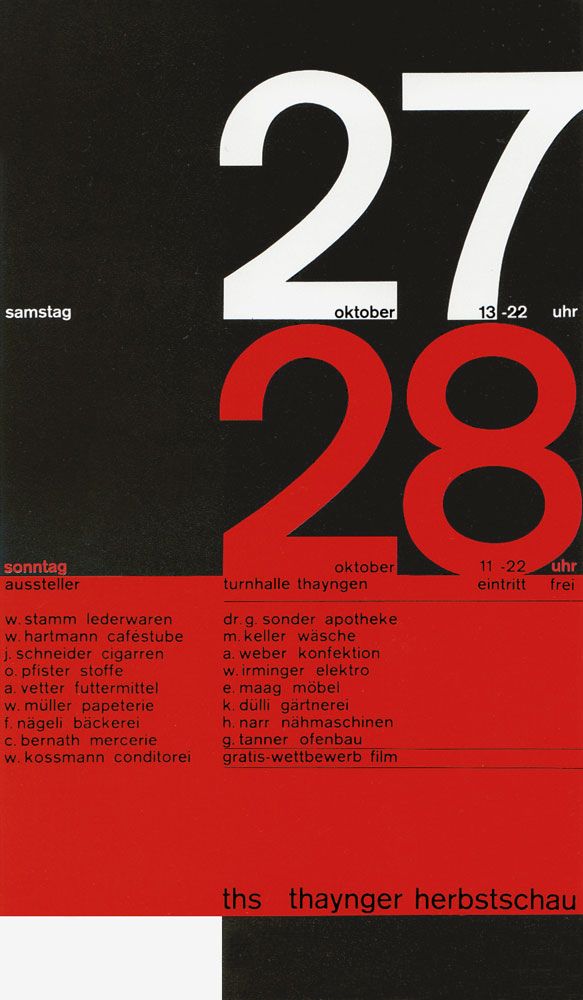
Poster for a weekend fall fair in Thayngen, Switzerland, 1956. Red indicates that the second day falls on Sunday, although Neue Grafik reproduced the work in black and white in Issue 1, September 1958.
‘When I started, it was of course a very good time for Swiss graphic design’, Tissi notes.4 During the 1950s, graphic design was becoming an increasingly prevalent force in everyday lives through advertising and packaging, posters and promotions; it was also coalescing into a recognisable career field. In 1955, Concrete painter and designer Karl Gerstner asked Alfred Roth, editor of the Swiss Werkbund journal Werk, if he might consider including an article on graphic design; Roth insisted on an entire issue devoted to the design industry, with Gerstner as commissioner, editor, and designer. Gerstner solicited articles and work samples from several of his design colleagues, among them Siegfried Odermatt.5
Five years earlier, Odermatt had opened his own studio; his clients ranged from pharmaceutical companies to printers. Here, Tissi soon began her second apprenticeship – which would, over the course of five decades, become a lifelong collaboration – with assignments in advertising and packaging. Her work received early recognition. Design journal and spokes-object of Swiss postwar modernism Neue Grafik featured one of her posters in its inaugural issue of September 1958. Created when she was just nineteen years old and selected for the issue by designer Hans Neuburg, the poster advertised a weekend fall fair in her home village of Thayngen. Tissi had designed it in her personal time, overnight, at Odermatt’s studio. ‘He was rather impressed by what he saw and praised my way of handling the composition’, Tissi recalls.6
Issue 2 of Neue Grafik, 1959, featuring Tissi’s advertisement design for the typesetting services of printing firm City-Druck, Zurich, 1958, at bottom right. Tissi positions a handful of lowercase letters as though they have been stored in a compositor’s case; typeset, they reveal the name of the company. (Image: Lineto)
Typografische Monatsblätter published the first solo feature of Tissi’s work in its November 1962 issue. Curator and art journalist Margit Staber, who would later become the first director of the Museum Haus Konstruktiv, authored an accompanying profile. Staber highlighted the ‘stimulating quality and uniqueness’ of Tissi’s designs, citing her particular interest in developing compositions ‘reminiscent of solving a puzzle’.7 Such letter puzzles are a hallmark of Tissi’s work in this issue: an enigmatically typeset card, printed on transparent paper, folds to complete a New Year’s wish; a logotype on a programme cover repeats as concrete poetry.
Staber also praised Tissi’s ability to find a path between ‘economic thinking aimed at mass consumption and creative, expert thinking’. She added, ‘For a young graphic designer, and especially for a young woman graphic designer, to assert oneself in this conflict of needs and desires is no small achievement’.8 Staber herself was well-poised to understand the challenges faced by women in predominantly male fields; hers was the art world, in which she worked most closely with Max Bill. In a later feature on Tissi’s work in the August / September 1965 issue of Typografische Monatsblätter, Staber again praised Tissi’s grit: ‘The fact that she is persevering on this path as a woman additionally speaks to her favour’, she wrote.9
Tissi is conscious of having worked as a designer during less gender equitable decades. In our conversation, she recalls how clients and colleagues often misattributed her work to Odermatt; they ignored her contributions, asking to speak directly to Odermatt instead. Male clients in particular doubted her abilities to execute work. ‘They think a woman can’t do good things’, Tissi explains to me, describing a pervasive sexist mindset. Odermatt was an exception: ‘He always pushed my work and my efforts’, she notes, adding ‘I think he was ahead of his time in that way’.10
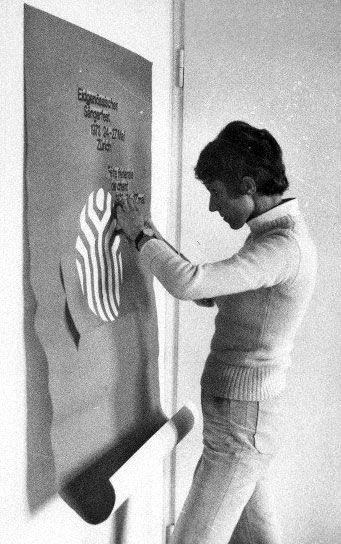
Tissi, thirty-five years old, at work on a poster for a Swiss choral festival, 1972.
From 1968 onward, Tissi and Odermatt entered into a business partnership, a move suggested by Odermatt in order to put the pair on more equal standing. ‘But it only kind of worked’, Tissi notes, as clients continued to ask to speak to her ‘boss’.11 Tissi attributes some of this sexism to Swiss culture, noting that women did not receive the vote until 1971, when she was thirty-four years old. ‘Switzerland is a macho country’, she tells me. The rest she attributes to jealousy and competition: ‘Most of them simply didn’t want to accept that a woman could also be successful’.12 Tissi remarks on how few woman design students continued into the professional field due to the pressures of marriage and child-rearing. As a result, she notes, ‘There weren’t that many female graphic designers in my daily life’.13
For Tissi, slights from male colleagues and clients served only as motivation. Her work, as Staber noted, is born of tenacity; her feminism lies in the lived experience of having succeeded in mostly male-dominated spaces, where such success was largely framed by men. Tissi’s accomplishments are their own demonstration against the gender imbalance that characterised the design field; her visibility is her protest.
Modernism to Postmodernism
Tissi and Odermatt’s studio was located in a loft at Schipfe 45, a prime location in downtown Zurich. Tissi’s desk overlooked Lindenhof Park; Odermatt’s, the Limmat River. They worked without assistants and maintained separate clients, although collaboration was nonetheless an important part of their dynamic. They discussed projects at the outset to determine who might best fit a given client’s needs; they also critiqued each other’s work throughout the design process.
Tissi has worked on a wide range of projects, both cultural and commercial. Her design process began – and still begins – with a blank sheet of paper, and often involves many drafts. She jumps between hand-sketching and, since 2000, computer software. Tissi generates all of her own artwork. She holds equal allegiance to serif and sans-serif typefaces, and mixes both with alphabets of her own design. She never begins with a grid: ‘I am freer in the way I work’, she notes.14 Semblances of alignments and geometric relationships underpin her work, only to break down in unusual ways. An overt symbology invests her minimal designs with unfolding stories and double meanings: graphic simplicity as synecdoche, rather than sparsity. Bright, solid colours punch through ambiguity. Tissi’s work communicates with a boldness approaching that of a signal, while nonetheless remaining a bit more mysterious, intricate, and unexpected.
Poster for Migros Klubschule, an institution promoting continuing education, Zurich, 1988.
Tissi’s posters in particular possess flag-like qualities: expressive, commanding, distinctive even at a distance; she describes using a ‘reducing glass’ as often as a magnifying glass in order to ensure legibility at different scales.15 Line, rectangle, circle; sun, moon, cloud: ‘These form-figures, partly architectural, partly playful, are quite free from all schematic rigidity’, noted curator and art historian Willy Rotzler in the March 1984 issue of Typografische Monatsblätter. ‘And the same applies to the choice of lettering and the principles of its use’, he added.16 For Tissi, even small type is fair game for off-grid explorations; it angles and bends, frames and contours.
Colleagues, critics, and historians often describe Tissi’s approach as ‘intuitive’, ‘playful’, and ‘spontaneous’ – a somewhat gender-tinged vocabulary. But these adjectives belie the hard logic that undergirds her designs. Tissi is a technician; in a minimal palette, she finds maximal resonance, visual and textual. With tactical rigour, she moves elements into position over multiple versions of a single work until she achieves near-diagrammatic clarity. ‘I do rough sketches in my head of countless ideas, model some of them in paper, move them around, test various designs. I see patterns and flows’, she explains.17 Rotzler remarked upon this ‘spontaneous “workshop” quality’ visible in the final work: ‘The observer is stimulated and feels that he is involved in a process, not just passively confronted by the finished product’.18
Poster series for an annual open-air concert programme, Serenaden, in the park of Villa Schönberg, Zurich. Image 1: 1993, Image 2: 2000.
Tissi credits this iterative working process with enabling her to systematically pursue new ideas and discoveries. Her free-form, exploratory methodology – designer Wolfgang Weingart called Tissi and Odermatt’s studio ‘more a kind of laboratory’ – has allowed Tissi to extend an otherwise rigid and dogmatic tradition of design into a more versatile, open-ended functionalism.19 In this sense, her works are adversarial – not against client or audience, but against the postwar Swiss design orthodoxy that would come to be known as the International Style.
The mid-century ubiquity of this style is difficult to underestimate. Publications like Neue Grafik – created and edited by the style’s lead practitioners – codified it into a methodology and movement. Designers could execute it formulaically: sans-serif typefaces, asymmetrical layouts, gridded arrangements, flush-left settings. ‘You didn’t need any imagination’, Tissi notes.20 On their surface, Tissi’s designs – especially her early works – play into similar visual tropes through her use of constructivist forms and emphasis on minimalism. ‘Work is often much better with less’, she argues, in a refrain that resonates well with modernism.21 Tissi directly acknowledges the International Style’s appeal and influence: ‘I like its cleanliness and clarity and all that, but’ – and it’s a critical ‘but’ for her – ‘it lacks joy’.22
‘Some of my work at the beginning was very Swiss, too, because I hadn’t found my way’, she notes. ‘But overall’, she adds, ‘Swiss design didn’t have soul’.23 Tissi has variously described it as ‘too grave and dignified’,24 ‘too heavy’,25 ‘too one-sided and geometrical’,26 ‘too cold and constructed’,27 and ‘too rigid, lacking vivacity’.28 Tissi’s channelling of joy, on the other hand, produces designs that are brightly lit, puzzle-like, idiosyncratic, and beckoning – anything but neutral. Yet she notably eschews the irony, kitsch, and pop of postmodernism; she strives instead at sincere messaging and resonance. Clear communication and originality are compatible in Tissi’s work; meanings bounce across a design and land without subterfuge.
Image 1: Poster for phototypesetting firm Englersatz, Zurich, 1983. Image 2: Cover of Graphis, Issue 241, January/February 1986, created in collaboration with Englersatz. Tissi retains the wireframes and coordinate systems of her extruded and rotated letters, emphasising the computer-aided means of their render. Both works share conceptual parallels with Tissi’s advertisement series for Schöb, with glyphs acting as architecture.
In her early years, Tissi recalls drawing inspiration from abroad more so than in Switzerland, particularly from American and Italian designers. She counts Paul Rand, Saul Bass, Gene Federico, George Tscherny, and Franco Grignani among her influences.29 Her attention to their work speaks not only to the development of her own style, but to the vibrant design atmosphere of the 1950s and 1960s. International exchanges of ideas and techniques were not only possible, but probable, through the growth of design schools, publications, exhibitions, competitions, and international conferences.
To develop an alternate visual language to what was then becoming one of Switzerland’s most valuable cultural commodities was roguish. As Weingart observed in a 1986 feature of the studio in Graphis, Tissi and Odermatt had evolved toward the position of ‘inspired outsiders’ within the very same Zurich design scene that had once nurtured them, and which they in turn had helped to develop. ‘It seems as though both returned from a long journey years ago to an exotic planet’, Weingart wrote – ‘from an exciting excursion on which they completely lost the hair-splitting, all too disciplined graphics of many of their colleagues’.30 Shunning universal appeal by diverting from the well-trodden path of modernism meant residing instead in the realm of cult appeal: the land of designers’ designers.
ABC to S
Detail from the original drawing of Sinaloa, 1972. Traces of Tissi’s design process can be seen in lightly pencilled grid lines and compass marks, black ink fills, and whited-out corrections.
Outsiderness might be the state in which Tissi feels most at home. She describes a disinterest in design trends, then and now; she does not recall socialising much in Zurich design circles. Quite the opposite: for several weeks or months at a time, Tissi would disengage entirely from design, leaving Switzerland for another part of the world. ‘I travelled without thinking about being a graphic designer’, she tells me. ‘If you think all the time about your profession’, she adds, ‘you lose the proportions’.
These trips served not as sources of inspiration, but immersive escapes. Tissi always travelled alone; accompaniment implied distraction. ‘Then you still have a piece of home with you’, she explains to me. She only rarely contacted family, friends, and colleagues. She shunned work assignments and declined to visit other design practitioners or studios during her travels. ‘My goal was my freedom’, she explains, ‘and with Odermatt I had that freedom. I could go and he would carry on working with the clients’.31 She found this distance from her work both necessary and renewing: she ‘would always come back a new person’.32
Suitcases rest on top of the bookshelves in her Zurich apartment. From a young age, Tissi recalls possessing what she describes to me as a ‘desire to discover the world’. Her first trip abroad was to the United States in 1963: ‘99 dollars for 99 days’, she recalls – a booming time for commercial air tourism. She rode by Greyhound bus to popular sites like the Grand Canyon and White Sands, then crossed south into the Mexican states of Sinaloa and Sonora, relieved to escape the bus’s air conditioning. Tissi travelled again to the United States and Mexico in 1966, and has returned to Mexico three times since. Leaving Switzerland – and her design work – for weeks or months at a time, she would often arrive back home with no assignments on the table. ‘To fill the time’, as she puts it, she began pen-and-ink experiments in typeface design. In 1972, during a particularly fruitful intermission between travel abroad and commissioned work, she created her first two alphabets: Sinaloa, and its variant, Sonora.
Original drawings of Sinaloa, prepared as camera-ready artwork, 1972. Tissi produced the glyphs at a height of five centimetres.
A variant of Sinaloa, Sonora features exclusively vertical stripes. These 1972 sheets served as source material for the Lineto releases.
Aside from basic instruction in type design during her art school years, Tissi is largely self-taught in letter-making. She begins with the characters ‘A’, ‘B’, and ‘C’, and then quickly moves to ‘S’. ‘If the “S” doesn’t work, none of it works’, she explains to me. Tissi has always turned to creating typefaces during lulls in her work. The COVID-19 pandemic led to a particularly productive period for her, during which she created five new alphabets.
Tissi’s typefaces are each named after her destinations abroad: Sinaloa, Sonora, Mindanao, Palawan, Sarawak, Vanuatu, and more; her type catalogue is a travelogue. But as Tissi notes, her alphabets are not souvenirs. Nothing is borrowed or appropriated; the letterforms share no graphic connection to the places after which they are titled. Tissi chose these particular destinations instead for their aesthetically pleasing letter combinations.
Tissi’s letterforms are case studies in miniature of the dimensionality she is able to achieve with flat, monochromatic surfaces. ‘It’s incredibly rewarding to design letters in that way, in challenging systems. It’s a different way of thinking and embracing the language of symbols’, she explains.33 Gradients and shadows make few appearances in her work; she relies instead on pattern and position to create optical illusions. Perspectives are ambiguous and unresolved; forms can be seen to both recede and approach simultaneously, a kinetic effect akin to a dolly zoom. Many of Tissi’s logos and logotypes, too, mine a similar territory of heightened dimensionality; curiosity piques over how she might have extended any single one into a full alphabet.
Logos and logotypes, left to right, top to bottom: Mettler Textiles, 1969; Lopes Gallery, 1976; Croba Bakery, 1971; proposal for Sony, 1978.
Tissi’s letterforms have a science fictional quality – not because the stripes in Sinaloa suggest warp speed, or because the pixellation in Sarawak invokes the digital age – but because they deeply estrange their audiences from the conventions of Swiss type design. ‘Everyone was using the same typeface’, Tissi recalls.34 Only one candidate comes to mind, also named after a geographical place: Helvetica. Tissi proudly notes that she has never used it in her work. Her alphabets strive for anything but Helvetica’s modernist qualities: supposed neutrality, legibility, sparsity. They are composed instead of highly inflected display letterforms – loud, logo-like, exclusively uppercase, and wholly unsuited to long-form reading. Tissi’s typefaces venture as far abroad from Helvetica as they possibly can; no wonder she has named them after her travels away.
Original drawing of Mindanao, prepared as camera-ready artwork, 1975. Tissi based this typeface on physical experiments in paper-folding. This sheet served as source material for LL Mindanao, a future Lineto release.
Letraset to Lineto
One of Tissi’s alphabets in particular has stirred the imaginations of designers everywhere and seeped into a global public consciousness. Sinaloa is a brazenly futuristic display typeface – part pattern, part geometric construction – and Tissi’s first commercially released alphabet. Published in 1974 by British lettering firm Letraset, in its top-tier Letragraphica range, Sinaloa ‘tapped into the zeitgeist of the 1970s’, explains typographer and designer Florian Hardwig.35
Used Letraset sheet, featuring Sinaloa at 72 points (18 millimetres). Obviating the need for traditional typesetting services, Letraset’s dry-transfer technology is one of many historical examples of the ongoing democratisation of design and design tools. (Image: Lineto)
Sinaloa is highly systematic, yet still sculptural; its eccentricity rounds out its hardness. It has no closed counters, linking it to a long tradition of stencil – a genre associated with speed, shipping, and travel. Its letterforms appear mid-materialisation, as if undergoing teleportation; they shimmer into focus through Tissi’s use of parallel lines. Interpretations of these stripes are endless: tonal gradations of sunrises, heat waves radiating off tarmacs, window shades admitting cool moonlight. As motion lines, they propel the letters into deep space. As optical patterns, they illusively mix figure and ground. As hatching, they contour flat forms into three dimensions in the manner of woodcuts. Sinaloa: a portal from Captain Kirk to Albrecht Dürer.
‘Tissi had a very clear idea of what she wanted those letters to be’, states Cornel Windlin, designer and founder of Swiss type foundry Lineto. ‘They are radical, kind of impossible – not aiming to please. The whole alphabet is really quite out there somehow’, he explains. Tissi agrees: ‘You cannot play around with them because they are so strong’, she tells me.
Poster for a concert series at the performing arts space Theater 11, Zurich, 1981. The work introduces a new logotype for the theatre, featuring the ‘11’ typeset in Sinaloa. This identity remains Tissi’s only application of Sinaloa in her own design work.
Nonetheless, Sinaloa abounds in use; as a Letraset typeface, it has found its way into the hands of thousands. Letraset sheets – peaking in sales throughout the 1970s and mid-1980s – were quick to buy, easy to use, and accessible to all; they soon spread from the professional design world to students, hobbyists, artists, and amateur designers. Following its 1974 release, Sinaloa – rather like Rosmarie herself – travelled around the world; it has appeared variously on a t-shirt in Vanuatu, in a British video game, as the logotype for the Citroën BX 4TC, and atop American musician Frank Zappa’s letterhead.
Page from a Letraset handbook, 1987, showing three available sizes of Sinaloa – 72 point, 60 point, and 48 point. (Image: Internet Archive)
On account of their ephemeral nature, many Letraset applications of Sinaloa are likely lost to time. But in the realm of music – rich with fans and collectors – the impact of Tissi’s typeface can be better visualised. Sinaloa took hold across nearly all musical genres and can be found on the album sleeves of established musicians, obscure groups, one-hit wonders, and popular song compilations alike. A tool like Letraset, with a lower barrier to entry, combined with the surface of the record cover – a more experimental environment for design – created the perfect conditions for Sinaloa to thrive.
Tissi granted publishing rights to Letraset in exchange for royalties, yet despite the typeface’s remarkable popularity, these payments ‘didn’t amount to much’, she recalls. In the 1980s, Letraset began digitising its collection of typefaces in cooperation with URW, and later with the International Typeface Corporation (ITC), which it acquired in 1986. Digitisation of Sinaloa likely took place sometime in the 1980s, without Tissi’s consultation or involvement; digital forensics by Lineto date the earliest known font file to 1986. Once digitised, Sinaloa quickly spread across the web, spawning multiple unauthorised versions with differing glyph sets. One such version included a lowercase alphabet, which Tissi had neither approved nor ever considered developing.
Examples of Sinaloa have abounded on music-related ephemera since the mid-1970s, up until today. Lineto collected over 70 record sleeves, for vinyl, CD and compact cassette. Image 1: Record cover for Beastie Boys, To the Five Boroughs, USA 2004. Image 2: Sir Kizitu Omon Imasuen, Self-titled LP, Nigeria 1977; Image 3: Johnny Paycheck, Country Greats In Concert, USA 1979. (Images: Lineto)
In 2020, Tissi established her claim to Sinaloa’s publishing rights and terminated its distribution by Monotype, Letraset’s successor. Three years later, she initiated a collaboration with Lineto for a new digital version of the typeface based on her drawings from 1972. Type designer Céline Odermatt – no relation to Siegfried Odermatt – worked closely with Tissi to expand the original alphabet from around fifty characters to over two hundred. Odermatt describes a process in which she and Tissi exchanged digital sketches, meeting in person to discuss and review proofs. Together, they untangled the multiple interventions made to Sinaloa in the years since Tissi first drew the typeface; their work ranged from remodelling the diacritics and punctuation initially produced by Letraset to removing unauthorised expansions found in digital font files. Revisions to the original alphabet included the development of entirely new glyphs for contemporary use as well as subtle optical adjustments to the stripes.
Céline Odermatt and Rosmarie Tissi working on LL Sinaloa, at Tissi’s Zurich apartment, 2024. Odermatt and Tissi exchanged digital sketches and often met in person to discuss and review proofs. (Image: Melanie Hofmann)
For Odermatt, preserving the tone of the original required ‘the surprise of working by hand’– a drafting process in which systematisation translated to coherence rather than conformity; she highlights the difference in stripe length and direction between the ‘$’ and ‘S’ glyphs as an interesting case study. Yet Sinaloa’s ‘multiline’ features – its stripes – are ancillary for Odermatt when characterising the typeface; she points instead to its distinctive ‘modularity’ and ‘bulkiness’. No conceivable design for a lowercase could complement the heft of the uppercase, she explains; it would be too light and round. She hesitates to place the typeface in a particular category or genre: ‘Sinaloa is really its own thing’, she argues.
Lineto’s release of Sinaloa – authorised by its original designer for the first time – now marks the typeface’s fiftieth anniversary in circulation. LL Sinaloa is complemented by the debut of its variant, LL Sonora; LL Mindanao will follow soon. Typefaces are tools by nature; once published, they are used by an unknowable audience, under uncontrollable circumstances. But it is the cavalier behaviour of type companies that Tissi’s redigitisation seeks to counter. From Letraset to Lineto, Sinaloa’s journey epitomises a half-century of evolution in type foundry services and design rights management. For Tissi to have control again of her creative output and its future direction is a powerful form of ownership and agency in the digital era.
Image 1: LL Sinaloa featured as part of the Lineto font library, Fall 2024. Image 2: Dry-transfer lettering sheets of LL Sinaloa and LL Sonora, produced on the occasion of Lineto’s re-release of Tissi’s typefaces. Edition of 50 sets (available from Lineto).
Basel and Beyond
Tissi has no plans to retire. ‘I like designing things and it never bores me’, she counters.36 After Siegfried Odermatt died in 2017 at the age of ninety, she moved out of their shared studio and now works from her apartment. She has donated comprehensive parts of her and Odermatt’s archive to the Swiss National Museum in Zurich, the Museum für Gestaltung Zürich, and the Plakatsammlung der Schule für Gestaltung Basel, as well as a privately-held design archive in Zurich.
In 2018, Tissi received the Swiss Grand Prix for Design, the highest achievement in design awarded by the Swiss Federal Office of Culture. ‘The award came very unexpectedly and made me very happy. It is certainly a great honour to be praised in this way’, Tissi states. ‘It also gives me the motivation to carry on with the projects I am working on at the moment’.37 The prize is perhaps the ultimate insider accomplishment for an outsider, and a reminder that Tissi’s independence, too, is an act of design.
Céline Odermatt addressing the crowd at the launch event for LL Sinaloa and LL Sonora, Basel Poster Collection, Fall 2024. (Image: Lineto)
In collaboration with Céline Odermatt at Lineto, Tissi recently launched a website showcasing her body of work at rosmarie-tissi.ch. Yet Tissi eschews the kind of self-promotion that lends itself to self-mythologisation and, eventually, historicisation. Her focus instead is on the work. Her standards for herself are her guide, and she continues to produce designs that can only be described as entirely her own. Her resilience generously creates space – for the possibility of other design worlds – and, more importantly, place – for the potential of independent designers. I inhabit this place with gratitude.
During the fall of 2024, Tissi found herself in Basel to attend an AGI Congress, a group exhibition featuring her work at Schule für Gestaltung (Rid the Grid – Women in Swiss Graphic Design 1900–1980), and Lineto’s exhibition dedicated to both Sinaloa’s legacy and the publication of Tissi’s new monograph, 12 Alphabets and Applications, installed at the Basel Poster Collection. Her travels continue: only Tissi knows her next destination, and the typeface it might name.
○ Contains interview with Tissi △ Features design work by Tissi □ Consulted as general reference
△ Berman, Felix. ‘Odermatt and Tissi: Plakate/ Affiches/Posters’. Typografische Monatsblätter, vol. 100, no. 3, May/June 1981, pp. 1–16. △ Bignens, Christoph. ‘Experimental Typography: The Work of Rosmarie Tissi’. Baseline, no. 33, pp. 17–24. △ □ Brook, Tony and Adrian Shaughnessy, eds. Letraset: The DIY Typography Revolution. London, United Kingdom: Unit Editions, 2023. □ De Bondt, Sara and Catherine de Smet, eds. Graphic Design: History in the Writing (1983– 2011). London, United Kingdom: Occasional Papers, 2014. △ de Harak, Rudolph, ed. Posters by Members of the Alliance Graphique Internationale, 1960– 1985. New York, New York: Rizzoli International Publications, 1986. △ Feigl, Günther. ‘Odermatt & Tissi, Zurich: Recent Work – Examples of Contemporary Typography’. Novum Gebrauchsgraphik, vol. 45, no. 2, February 1974, pp. 34–41. □ Fornari, Davide, et. al. Swiss Graphic Design Histories. Zurich, Switzerland: Scheidegger & Spiess, 2021. △ Friedl, Friedrich. ‘Odermatt & Tissi’. Novum Gebrauchsgraphik, vol. 62, January 1991, pp. 30–35. △ Friedl, Friedrich. ‘Rosmarie Tissi’. Laureaci XI Międzynarodowego Biennale Plakatu. Warsaw, Poland: Poster Museum at Wilanów, 1988. △ Gassner, Christof, Michael Schneider, and Günther Kopp, eds. Typographie: Schrift und Graphik mit Letraset. Darmstadt, Germany: Institut für neue technische Form, 1978. □ Gerstner, Karl, ed. Werk: Sonderheft Grafik, vol. 42, no. 11, November 1955. △ Hardwig, Florian. ‘Florian Hardwig on Tissi Type’. In Rosmarie Tissi, 12 Alphabets and Applications. Zurich, Switzerland: About Books, 2024. △ Hardwig, Florian, ed. ‘Sinaloa’. Fonts in Use, fontsinuse.com/typefaces/3967/sinaloa. Accessed August 2024. △ □ Henrion, F.H.K. Top Graphic Design: Examples of Visual Communication by Leading Graphic Designers. Zurich, Switzerland: ABC Verlag, 1983. △ □ Hollis, Richard. Swiss Graphic Design: The Origins and Growth of the International Style, 1920–1965. New Haven, Connecticut: Yale University Press, 2006. △ Hölscher, Eberhard. ‘Advertisements for a “Records Only Store”’. Gebrauchsgraphik, vol. 30, no. 3, March 1959, pp. 22–27. ○△ Holster, Linda. Hall of Femmes: Rosmarie Tissi. Stockholm, Sweden: Hall of Femmes, 2022. △ Ifert, Gérard. ‘Graphic Designers of the new generation’. Neue Grafik, no. 2, July 1959, pp. 21–37. △ □ Jubert, Roxane. Typography and Graphic Design: From Antiquity to the Present. Paris, France: Flammarion, 2006. □ Lange, Martha Scotford. ‘Is There a Canon of Graphic Design History?’. AIGA Journal of Graphic Design, vol. 9, no. 2, 1991, pp. 3–5, 13. From The People’s Graphic Design Archive, peoplesgdarchive.org/item/14326/is-there-a-canon-of-graphic-design-history. Accessed August 2024. ○△ Lechner, Herbert. ‘Rosmarie Tissi (SWI): “I never started with a grid”’. Novum, no. 8/9, October/September 2020, pp. 14–19. □ Lichtenstein, Claude. Playfully Rigid: Swiss Architecture, Graphic Design, Product Design, 1950–2006. Baden, Switzerland: Lars Müller Publishers, 2008. △ Lohse, Richard Paul. ‘Special issue: Odermatt and Tissi’. Typografische Monatsblätter, vol. 98, no. 1, January/February 1979, pp. 1–36. △ □ Meggs, Philip B. and Alston W. Purvis. Meggs’ History of Graphic Design, 4th ed. Hoboken, New Jersey: John Wiley and Sons, 2006. △ Morgan, Ann Lee, ed. ‘Odermatt, Siegfried/ Tissi, Rosmarie’. Contemporary Designers. London, United Kingdom: St. James Press, 1985. □ Müller-Brockmann, Josef. A History of Visual Communication. Teufen, Switzerland: Arthur Niggli, 1971. ○△ Munari, Nicola-Matteo. ‘Rosmarie Tissi: Q&A’. Designculture, designculture.it/interview/rosmarie-tissi.html, December 2014. Accessed August 2024. △ Neuburg, Hans. ‘Recent New Year Greeting Cards’. Neue Grafik, no. 13, June 1960, pp. 49–56.
△ Neuburg, Hans. ‘Publicity and Graphic Design’. Neue Grafik, no. 9, March 1961, pp. 32–59. △ Neuburg, Hans. ‘The best recently designed Swiss Posters, 1931–1957’. Neue Grafik, no. 1, September 1958, pp. 52–63. △ Niemeyer, Phillip. ‘Albers, Lustig Cohen, Tissi: 1958–2018’. Pratt Manhattan Gallery, pratt.edu/wp-content/uploads/2022/08/alberslustigcohentissi.pdf, 2018. Accessed August 2024. △ Nunoo-Quarcoo, Franc and Cynthia M. Wayne. Word and Image: Swiss Poster Design, 1955–1997. Baltimore, Maryland: Albin O. Kuhn Library and Gallery, University of Maryland, 1998. △ Odermatt, Siegfried. 100 + 3 Swiss Posters. Zurich, Switzerland: Waser Verlag, 1998. △ Odermatt, Siegfried and Rosmarie Tissi. Odermatt & Tissi: Graphic Design. Zurich, Switzerland: Waser Verlag, 1998. △ ‘Odermatt & Tissi, Zurich’. High Quality, no. 5, May 1986, pp. 10–17. ○ Paradis, Louise. ‘Odermatt & Tissi: Interview’, TM RSI SGM 1960–90 Research Archive, January 2011, tm-research-archive.ch/interviews/odermatt-tissi%E2%80%8A. Accessed August 2024. ○△ Roberts, Lucienne. ‘Rosmarie Tissi’. Drip-Dry Shirts: The Evolution of the Graphic Designer. Lausanne, Switzerland: AVA Publishing, 2005. △ Rotzler, Willy, Fritz Schärer, and Karl Wobmann. Das Plakat in der Schweiz. Schaffhausen, Switzerland: Edition Stemmle Verlag, 1990. △ Rotzler, Willy. ‘Odermatt & Tissi: Posters as Processes’. Typografische Monatsblätter, vol. 103, no. 3, March 1984, pp. 7–18. ○ Sacchetti, Vera. ‘Interview with Rosmarie Tissi’. Swiss Culture Awards, Federal Office of Culture, January 2018, https://www.schweizerkulturpreise.ch/awards/de/home/design/design-archiv/design-2018/design-gpd-2018/tissi-rosmarie.html. Accessed August 2024. ○△ Schoen, Raphael. ‘In Macho Country: A Conversation with Rosmarie Tissi’. Weltformat Magazine: Not Yet Cancelled, September 2020, pp. 15–23. □ Scotford, Martha. ‘Messy History vs. Neat History: Toward an Expanded View of Women in Graphic Design’. Visible Language, vol. 28, no. 4, 1994, pp 367–388. From Graphic Design Reading, readings.design/PDF/messy-history-vs-neat-history-toward-an-expanded-view-of-women-in-graphic-design.pdf. Accessed August 2024. △ ‘Siegfried Odermatt und Rosmarie Tissi: Typografie von Geschäftsdrucksachen’. Typografische Monatsblätter, vol. 87, no. 2, February 1968, pp. 109–120. △ Staber, Margit. ‘Arbeitsproben von Rosmarie Tissi, Zürich’. Typografische Monatsblätter, vol. 81, no. 11, November 1962, pp. 705–712. △ Staber, Margit. ‘Arbeitsproben von Rosmarie Tissi, Zürich’. Typografische Monatsblätter, vol. 84, no. 8/9, August/September 1965, pp. 587–594. △ Staber, Margit. ‘New Year Cards’. Neue Grafik, no. 13, June 1962, pp. 55–59. △ Staber, Margit. ‘Odermatt & Tissi: A Graphic Studio in Switzerland’. Gebrauchsgraphik, vol. 42, no. 4, April 1971, pp. 38–45. △ Staber, Margit. ‘Siegfried Odermatt’. Graphis, vol. 20, no. 113, 1964, pp. 250–258. ○△ Supon Design Group. ‘Rosmarie Tissi’. International Women in Design. New York, New York: Madison Square Press, 1993. △ ‘The World Masters: 18 Siegfried Odermatt & Rosmarie Tissi’. Idea, vol. 41, no. 237, March 1993, pp. 20–27. △ Tissi, Rosmarie. 12 Alphabets and Applications. Zurich, Switzerland: About Books, 2024. △ Tissi, Rosmarie. ‘Rosmarie Tissi’. rosmarie-tissi.ch. Accessed August 2024. ○△ Tissi, Rosmarie. Rosmarie Tissi: Graphic Design. Zurich, Switzerland: Triest Verlag, 2019. ○△ Watano, Shigeru and Yachiyo Matsuzaki. ‘Here Again, Today...: Swiss Style of Odermatt & Tissi’. Idea, vol. 38, no. 221, July 1990, pp. 82–87. △ Weingart, Wolfgang. ‘Odermatt & Tissi: Two Swiss Graphic designers who always do everything different’. Graphis, vol. 42, no. 241, January/February 1986, pp. 40–51. △ Wills, Franz Hermann. ‘“UNIVAC”: The Product – Image of a Computer’. Gebrauchsgraphik, vol. 38, no. 12, December 1967, pp. 50–56. △ Wolf, Thomas. ‘S. Odermatt, Zurich: Commercial Art from the Point of View of the Client’. Typografische Monatsbätter, vol. 83, no. 3, March 1964, pp. 175–190.