By Rikard Heberling and Jonas Williamsson— In 2020, Lineto introduced Munken Sans, a new corporate typeface created for the paper manufacturer Arctic Paper. Designed by Laurenz Brunner and Selina Bernet, the typeface was inspired by Tratex, Sweden’s distinctive road sign alphabet and a defining feature of the country’s public space.
Originally designed in the 1960s and known for decades as Gepos/Geneg, the alphabet was digitized in the early 2000s, renamed Tratex, and made freely available online by the National Road Administration of Sweden. What had once existed solely as technical drawings for professional use by sign manufacturers now became publicly accessible as PostScript and TrueType fonts. This enabled the letterforms to be used far beyond their intended purpose, in everything from books to corporate identities. Digitization also altered how the alphabet’s history was understood, transforming anonymous engineering work into attributed design, while obscuring aspects of its material reality, institutional background, and cultural history.
As part of developing Munken Sans, we set out to reconstruct the fragmented history of this alphabet – work that culminated in the book Tratex: A road sign alphabet in the making (Lineto, 2025). Alongside a full reproduction of the original 1966 technical drawings of Gepos/Geneg, it includes an essay tracing the alphabet from its beginnings to its digital life. What follows is an abridged version of that essay.
Sign manufacturing company Plast & Plåt Vägmärken in Kållered, Sweden, 1983. Image: Harry Moum, courtesy of Mölndals stadsmuseum.
A Type For Our Time
In 1928, German typographer Jan Tschichold’s The new typography was published in Berlin. Written as a manual for typographers, its central argument was the need to discard conventions in printing that were no longer relevant to industrial production. New technology and new ways of reading had made older letterforms problematic. Roman, italic, and blackletter typefaces, influenced by calligraphic traditions, had evolved under technical and social conditions that had changed radically in the twentieth century. Moreover, archaic letterforms reflected conservative notions of national and cultural exceptionalism, which Tschichold saw, against the background of the Great War, in direct opposition to democracy and internationalism. The ideal typeface for modern society had to be as universal as possible in order to facilitate communication. Tschichold saw this quality in the letterforms of the industrial age, especially sans serif typefaces. However, in 1928, a perfect version of this letterform was yet to be designed:
[...] all the attempts up to now to produce a type for our time are merely ‘improvements’ on the previous sanserifs: they are all still too artistic, too artificial, in the old sense, to fulfil what we need today. Personally I believe that no single designer can produce the typeface we need, which must be free from all personal characteristics: it will be the work of a group, among whom I think there must be an engineer.1
The engineer – or rather, engineers in the plural, in contrast to the singular figure of the artist – played a pivotal role in shaping this new era. For Tschichold, the ‘type for our time’ was indeed our type: it had to embody the spirit of collectivism. The rational approach of the engineer was to replace the fashionable ‘artistic’ tendencies and personal idiosyncrasies that permeated contemporary type design. Individual expression had to be rejected in favour of function and objectivity. Influenced by socialism and the belief that new technology could advance democratization, Tschichold’s work was a reaction against the injustices of class society. He saw standardization and mass production as means to achieve economic equality.
Regulations for alphabet and direction sign, 1931. Swedish code of statutes, 1931: 252.
A Standard In Progress
Conceived around 1930 by the government agency responsible for roads, the first standardized road sign alphabet in Sweden aligns with Tschichold’s vision in that it was developed collectively by a group of engineers and resulted in a design that cannot be accused of being ‘too artistic’. On the contrary, its form was primarily developed to fulfil the objective function of a sign system for navigation.
As infrastructures grew larger and more complex, and traffic speeds increased, the legibility of road signs became more crucial. The rise of international travel also necessitated signs with a more universal character. This led to several initiatives in the inter-war period aimed at international standardization of road signs. The Geneva Convention concerning the Unification of Road Signals, presented by the League of Nations in 1931, was ratified by most European countries by the end of the 1930s.2 In Sweden, the first official regulations concerning the design of road signs were issued in 1931, introducing a set of signs to indicate direction and distance to places, and an alphabet for place names.3 The following decades would see many developments, not only in the alphabet and pictorial signs, but also in the materials and methods used in the production of sign plates, along with an overall increase in the number of signs and regulations.
Unlike text on a printed page, text on a road sign must be designed to be understood while the reader is moving, viewing it from different angles in varying lighting, weather, and landscape conditions. As motorization increased and traffic systems grew more complex, these issues became more and more important to the designers of road signs.
Modified alphabet and direction signs, 1937. Swedish code of statutes, 1937: 44.
New regulations for Swedish road signs were already issued in 1937, slightly altering the 1931 alphabet.4 During the 1940s, sign plates with the ability to reflect vehicle lights became a concern to improve visibility at night, and in 1951, regulations were introduced that required certain warning signs, unless externally illuminated at night, to be equipped with reflectors or made of reflective material.5 By the mid-1950s, a reflective coating was generally applied to all sign plates. The alphabet was also modified again; some capitals were widened and the two-storey ‘a’ was changed to a single-storey ‘ɑ’.6
Modified alphabet and direction sign, 1951. Swedish code of statutes, 1951: 744.
The second half of the 1950s saw further developments in terms of visibility which led to new signs being officially ratified in 1961. Letters and pictorial symbols were now to be mounted with reflective material on a non-reflective background and, with the exception of signs for private roads, text was to be set in capitals only.7 The alphabet had also been revised one more time, with many letters compressed horizontally to save on material costs. For this reason, the 1961 alphabet was later informally called ‘snålstilen’ – the stingy style.8
The Modell 60 alphabet, introduced in 1961. Image: Örebro Kuriren, courtesy of Örebro läns museum.
The official name, Modell 60, referred to the complete design of the road signs, including a grid system which assigned fixed positions to text, road numbers, and pictorial symbols. Groups of information were separated by borders, and dimensions were derived from a table based on the number of letters required.9 This grid system allowed local authority employees to easily draw up a construction plan before placing an order with the manufacturer.
Table for determining the sign length (‘tavellängd’) relative to the number of letters (‘antal bokstäver’) for text set in the Modell 60 alphabet, in 120 mm and 170 mm, respectively. From: Frih and Gustafson.
Developing Gepos/Geneg
At 5 in the morning on Sunday, 3 September 1967, Sweden changed from driving on the left-hand side of the road to driving on the right-hand side. Many of the traffic rules had to be updated and the road signs were reorganized according to the new way of driving. As part of this process, the alphabet that would eventually become known as Gepos/Geneg, later Tratex, was developed. A set of technical drawings was completed in 1966, and a sample appeared in the revised road sign regulations of the same year.10
The 1966 regulations for road signs use the capitals-only alphabet of Modell 60. At the same time, the new Gepos/Geneg design is introduced for words written with lowercase letters on special direction signs, including for private roads (‘Loftbacken 2’). Swedish code of statutes, 1966: 270.
Gepos/Geneg was partly developed out of a need for lowercase letters that had not been designed for the Modell 60 version of the alphabet. This is reflected in the name; ‘Ge’ is short for ‘gemener’, the Swedish word for lowercase letters (and ‘pos’/‘neg’ stands for positive/negative text).11 The majority of text in signs was still to be set in capitals only, but a number of special signs were henceforth to feature lowercase letters with capital initials: signs for private roads; an increasing number of smaller supplementary plates; signs for public facilities such as post offices, hospitals, pharmacies, libraries; and signs for bicycle and pedestrian traffic.
The invention of new reflective materials also necessitated a review of the overall design and production of road signs. In the Modell 60 sign plates, reflective material was used only for the text and pictorial symbols, which were mounted on a non-reflective background. Because of this limited reflectivity, many signs required external illumination, which was costly.12 With new and more affordable reflective materials available, it made more sense to make signs fully reflective. However, when the Modell 60 alphabet – originally designed to be space-efficient in order to save on reflective material – was tested on the new fully reflective sign plates, a halo effect appeared around its thin strokes, making the letters difficult to read at night. To maintain good legibility, the new material required letters with increased stroke width. For this reason, Gepos/Geneg was eventually developed not only for the signs that used lowercase letters, but for all text in all signs, replacing the Modell 60 capitals. It was implemented in two versions: a thicker version for signs with reflective backgrounds, primarily used for motorized traffic; and a thinner version for signs with non-reflective backgrounds for slower-moving traffic such as pedestrians and cyclists.
The two versions of Geneg with different stroke widths. Left: sign for cyclists with a non-reflective background. Right: fully reflective sign plate for high-speed traffic.
At the same time, increasing traffic speed and volume demanded more varied text sizes. The 1931 regulations had set the standard height of a capital letter at 105 mm, which was later increased to 120 mm in 1937. The first Gepos/Geneg technical drawings from the 1960s included letter heights ranging from 60 to 170 mm, and eventually ten specific sizes ranging from 22 to 400 mm were defined to meet the needs of both pedestrians and motorists.13 Given that thicker and larger letters could potentially have led to larger signs and higher production costs, and since material savings remained a priority, the Modell 60 layout system was also revised to optimize the sign display area. A more flexible grid was developed to better accommodate text and pictorial symbols. After several experiments were conducted throughout the 1970s,14 the fully reflective signs finally became mandatory in 1978.15 The revised system, in the end called Modell 80, was implemented in the following years, with the previously used non-reflective dark blue background changing to a highly reflective light blue.
Comparison of the design principles for Modell 60 (left) and Modell 80 (right). From: Utformning av lokaliseringsmärken.
The Work Of A Group
From 1944, the governing bodies responsible for public road signs in Sweden were the Department of Roads and, from 1958, the Department of Traffic. Both operated under the authority of the Royal Board for Public Road and Water Structures. Following the switch to right-hand traffic in 1967, the National Traffic Safety Administration was established as a new government agency overseeing all road safety matters, including the design of road signs.
The engineers working for these government agencies, designing alphabets for the public realm, recall Tschichold’s vision of the 1920s. The surviving technical drawings attest to the involvement of several individuals in the design process, as most of them bear at least two signatures.16 These markings should not be confused with artists’ signatures, which indicate authenticity and originality. Instead, they functioned as seals of approval and accountability; Axel Berglind, Gustav Ekberg, Bertil Frih, Karl-Gustaf Gustafson, and Erik Lundeberg are some of the employees at the Roads and Traffic departments in the 1950s and 1960s whose names appear on many of the drawings from those years. Although it is difficult to determine to what extent a particular individual was involved in drawing the letters and pictorial signs, the engineers who signed the drawings were at least responsible as supervisors in the project.
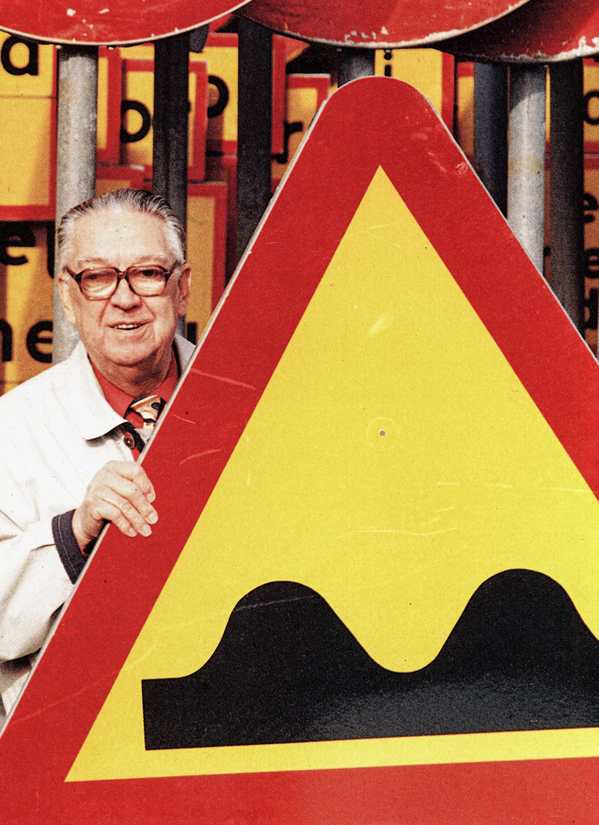
Karl-Gustaf Gustafson featured in the December 1997 issue of the National Road Administration’s employee magazine, Våra vägar.
Later on, it is mainly Gustafson who has been credited as the designer of most of the pictorial signs and of the Gepos/Geneg alphabet.17 Although he is often referred to as a ‘designer’ or ‘illustrator’, he actually worked as an engineer, or ‘byråingenjör’ in Swedish, which was his official job title throughout his career.18 Around 1936, at the age of 19, he had enrolled in an evening painting course in his hometown of Borås and subsequently had taken a position as a draughtsman in the city’s surveying department. Aside from a correspondence course in engineering, he had no formal higher education and described himself as an autodidact.19 In 1948, Gustafson began working at the Department of Roads in Stockholm and soon became involved in designing many of the new road signs introduced in the 1950s.
He was also engaged in redesigning the alphabet for the Modell 60 road signs, and he was responsible for developing Gepos/Geneg. His initials, ‘KGG’, appear on many surviving drawings from the 1960s and 1970s, often alongside ‘CB’ – Chester Bernsten – who began working as an engineer at the National Traffic Safety Administration in 1973. After Gustafson retired in 1978, Bernsten and other colleagues, particularly Roland Lithander, continued developing the design principles for Gepos/Geneg and the Modell 80 grid system. They collaborated closely with the Administration’s internal drawing office, which consisted of a small team of draughtsmen responsible for producing technical drawings and prototypes.20
Interviewed in 1997 on the occasion of his 80th birthday, Gustafson stated that one of the advantages of his profession was its independence: ‘I was pretty much on my own with my work.’21 While Gustafson was responsible for many of the drawings, much of his work was also based on previous designs of colleagues at the various agencies. As the pictorial signs and letterforms were repeatedly modified, new designs drew on earlier ones in a pragmatic and unsentimental way. For example, what later became the characteristic M in the Gepos/Geneg alphabet had originally been designed in the mid-1950s as a new sign for passing places on single-lane roads (M stands for ‘mötesplats’, meeting place). A technical drawing of this M, dated 1954, is signed by Ekberg and Berglind.
The ‘M’ of Gepos/Geneg evolved from the sign for passing places on single-lane roads, originally designed in the mid-1950s. Left: Technical drawing c. 1954, courtesy of Trafikverkets Arkivcenter. Right: The current version of the sign. Swedish code of statutes, 2007: 90.
But even more generally, the overall design of Gepos/Geneg was based on the Modell 60 alphabet – with technical drawings signed by Frih and Gustafson – which in turn was based on the previous alphabet of 1951, which in turn was a modified version of the alphabets of 1937 and 1931. In this respect, there is no single designer behind Gepos/Geneg, although it is fair to say that Gustafson, in collaboration with Bernsten and other colleagues, was responsible for completing a long process spanning several decades of designing the alphabet for Swedish road signs.
Territorial Pissings
The standards developed between the 1960s and the 1980s are still largely in use today. This is not to say that there have not been attempts to revise Modell 80. Given that the creators worked in a profession – engineering – that had not traditionally been concerned with letterforms and graphic symbols, Gepos/Geneg has at times been dismissed by graphic designers as a ‘product of engineers’ that has ‘nothing to do with good typography’.22 In fact, Modell 80 was barely implemented before it became the subject of discussion, and already in 1985, the National Traffic Safety Administration took the initiative to develop the ‘next generation’ of road signs.23 The agency hired a consultant, engineer Jan-Ola Sandberg, who presented a preliminary report in 1986 recommending that the system of mostly uppercase text be replaced with one that generally used lowercase letters with capital initials.24 This would improve legibility, Sandberg argued, and also be more space-efficient. He proposed to switch to a 1973 alphabet by graphic designer Bo Berndal – who happened to advise Sandberg on the report – called Sispos/Sisneg. This alphabet had been introduced by the Swedish Institute for Standards and was intended for ‘posters, signs, road signs etc.’, implicitly appearing as a competitor to Gepos/Geneg.25 Considering further options, Sandberg also recommended DIN Mittelschrift, Helvetica, and Univers as useful models for developing a new alphabet for Sweden’s road signs.
Front cover of a 1973 brochure issued by the Swedish Institute for Standards, presenting Bo Berndal’s Sispos/Sisneg alphabet.
When the National Traffic Safety Administration ceased to exist in 1993, responsibility for road signs was transferred to the National Road Administration. Sandberg continued the project, and in 1994 he presented a new report, working in collaboration with graphic designers Arne Olovsson and Leif Thollander. The need for a ‘complete overhaul’ of the current system was declared, citing increased traffic and the necessity of enhancing legibility.26 The Gepos/Geneg alphabet was criticized for not being ‘rooted in the 500-year-old tradition of Western lettering and typography’, as the letters were based on geometric shapes – arcs and straight lines of uniform width, constructed on a grid using a ruler and compass.27 For the same reason, DIN Mittelschrift and Helvetica were now rejected, in contrast to the findings of the 1986 report. Instead, the consultants recommended the alphabet used in British road signs, known as Transport, as the model for a new alphabet, which they regarded as being in close affinity with classical Roman letterforms, highly legible, and ‘expressive’ compared to geometric sans serifs.28 Based on their new findings, the consultants drew up a proposal for a new alphabet for Swedish road signs.
Sample of the new road sign alphabet proposed by Jan-Ola Sandberg, Arne Olovsson, and Leif Thollander in 1994. From: Olovsson, Sandberg and Thollander.
In 1997, the National Road and Transport Research Institute organized extensive tests which compared the alphabet by Sandberg, Olovsson, and Thollander with five competitors: Sispos/Sisneg, Transport, Dansk Vejtavleskrift (Denmark’s road sign alphabet, a modified version of Transport), and two versions of Gepos/Geneg – one in lowercase letters with capital initials and one in capitals only. Concerning legibility, the tests ended in a draw between the consultants’ proposal and the capitals-only version of Gepos/Geneg; Sispos/Sisneg came in last.29 While the proposed letters by Sandberg and his colleagues would use less space than Gepos/Geneg, reducing material costs in the long run, the potential benefits of a complete overhaul of the existing system now had to be weighed against the economic costs and labour involved in such a change. Gepos/Geneg had been in use for more than two decades, and the tests failed to clearly demonstrate that a new alphabet would offer significant advantages in terms of cost-efficiency and road safety. Although the test method can be questioned in that familiarity of users with the existing system might have favoured Gepos/Geneg, no additional experiments were undertaken. The development of a new alphabet came to a standstill.30
Alphabets used in the 1997 comparative tests. Left side from top to bottom (‘Barmvara’): Transport; Dansk Vejtavleskrift; Sisneg; the new proposal by Sandberg, Olovsson and Thollander; Geneg; capitals-only Geneg. Right side from top to bottom (‘Lillbygg’): The new proposal; Geneg; Transport; Dansk Vejtavleskrift; capitals-only Geneg; Sisneg. From: Herland and Helmers.
Common Letters Gone Corporate
The conversion of Gepos/Geneg to a digital typeface a few years later was driven by changing production methods. A common method of manufacturing the sign plates had long involved mechanically cutting the letters from the reflective material using dies, then mounting them with heat onto the background surface. Some manufacturers used stencils to ensure consistent spacing and alignment of the letters. Before mounting, the stencils were arranged side by side on the background material, and each letter was positioned within its respective stencil.31 By 1987, Sandberg noted that sign manufacturers were increasingly working with computers.32 Around the same time, the National Traffic Safety Administration converted the drawings of Gepos/Geneg into digital CAD files to facilitate the die-cutting process. Soon it was also possible to type text directly into software, so that signs could be digitally composed and printed as a single unit. However, the long process of developing and testing Sandberg’s proposal for a new alphabet may explain why digitization was not pursued any further during these years. Only in late 2001, while still working at the Administration, Bernsten commissioned graphic designer Karl-Erik Wångstedt to convert the CAD files into PostScript and TrueType fonts using Macromedia Fontographer. The CAD files had contained rectangles around each letter to indicate the distance to other letters, and these measurements were transferred to the font files. No changes were made to the letter spacing. Wångstedt acknowledged Bernsten and Gustafson in the metadata of the new font files, based on Bernsten’s account of the project. The new name, Tratex, was Bernsten’s idea: simply an abbreviation of ‘trafiktext’.33
Fontographer window with vector points of Tratex ‘S’ (left), and Tratex font files folder from a CD-ROM issued by the National Road Administration, 2002 (right).
When the National Road Administration made Tratex publicly available in 2002, writing the history of the alphabet was not a concern. Publishing the fonts on the Administration’s website was primarily a way of distributing them to sign manufacturers. However, as Tratex became accessible to anyone with a computer, the alphabet began to spread beyond its original purpose, indirectly contributing to how the history of Gepos/Geneg was perceived. Wångstedt’s initiative to credit Gustafson and Bernsten ensured their names would be linked to the alphabet in the future, yet several other aspects of Gepos/Geneg were lost in the process of digitization and online distribution. For instance, the thin version of the alphabet was not included and, as a consequence, has largely remained overlooked in historical accounts. The same can be said of the collective working environment and the material conditions that shaped the design process: a history for which there is no room in the metadata of computer fonts.
The conversion of the Gepos/Geneg drawings into digital formats was part of the broader digital transformation of society, which became increasingly apparent in the 1990s. Tratex was the National Road Administration’s response to the emerging technological standards of the period. Simultaneously, computerization created new demands for visual communication and corporate branding, with digital typography playing a central role. Since then, the market for digital typeface design has grown significantly and several other digital renditions of Gepos/Geneg have been produced. These fonts have been used in advertising, corporate identities, publications, and so on. Interestingly, the new renditions were often copyrighted and sold by individual designers or design companies, sometimes with a reference to Gustafson as a historical curiosity. In other words, as the original purpose of serving a common infrastructure has expanded to include other uses, the Gepos/Geneg alphabet has become as much a symbol of private property and individuality as it has remained a tool designed to aid orientation in public spaces. For sure, a common alphabet for the public realm may not be as important as it once was, given the privatization of public services and the changing technologies that determine how people navigate physical space. Yet regardless of how the Gepos/Geneg alphabet will be used in the future, it will always remain a monument to the society envisioned by Tschichold and others: a society shaped by engineers.
Tratex in use today — ‘Area closed to traffic’
Tschichold, The new typography, 74.
Schipper.
Swedish code of statutes, 1931: 252. For earlier efforts to introduce standardized road signs in Sweden which predate the 1931 regulations see Gustafson; Statens maritima och transporthistoriska museer.
Swedish code of statutes, 1937: 44.
Swedish code of statutes, 1951: 744.
Statens maritima och transporthistoriska museer.
Swedish code of statutes, 1961: 602.
Bernsten.
Frih and Gustafson, 13–14.
Swedish code of statutes, 1966: 270.
Bernsten.
Utformning av lokaliseringsmärken,3.
Vägvisning.
Nygaard.
Swedish code of statutes, 1978: 1001.
The drawings are preserved in the archives of the National Traffic Safety Administration [Trafiksäkerhetsverket] and the National Road Administration [Vägverket], held at Trafikverkets Arkivcenter in Mölndal, Sweden.
See, for example, Eckert et al., 250; Eriksson; Nilsson.
According to Wellman (who is Gustafson’s son-in-law).
Nilsson, 45. According to Eriksson, 21, Gustafson attended a ‘crafts course’ [konsthantverksutbildning] in 1937–1938.
Bernsten.
Eriksson, 21.
See, for example, Johansson, 44; Nordling, 78.
Sandberg. Versal/gemen text på lokaliseringsmärken, 1.
Sandberg. Text, typsnitt, läsavstånd på lokaliseringsmärken,1.
Bokstäver och siffror för anslag, skyltar, vägvisare m.m.
Olovsson et al., 6, 35.
Ibid.
Ibid.
Herland and Helmers.
Sandberg. Telephone conversations with the authors.
Sedin.
Sandberg, Framtida lokaliseringsmärken, 8.
Bernsten; Wångstedt.
Bibliography:
Bernsten, Chester. Telephone conversations with the authors. 4 April 2019, 9 June 2021, 8 September 2021.
Bokstäver och siffror för anslag, skyltar, vägvisare m.m.: teckensnitt Sispos och Sisneg: svensk standard SIS 030011. Stockholm, Sweden: Sveriges standardiseringskommission, 1973.
Eckert, Johannes, Christian Fischer, Ilona Pfeifer, Philipp Schäfer and Andreas Uebele, eds. Schrift und Identität: Die Gestaltung von Beschilderungen im öffentlichen Verkehr. Sulgen, Switzerland: Niggli Verlag, 2013.
Eriksson, Gerd. ‘Alla ser K-G:s märken’. Våra vägar: tidning för anställda, berörda och intresserade, 8, 1997, pp. 20–21.
Frih, Bertil and Karl-Gustaf Gustafson. Rätta vägmärken på enskilt område. Stockholm, Sweden: Industriförbundets förlag, 1967.
Gustafson, Karl-Gustaf. ‘Vägmärken förr och nu’. Vägen går vidare: Vägverket 150 år. Skara, Sweden: Skaraborgs länsmuseum, 1991, pp. 52–58.
Herland, Lisa and Gabriel Helmers. Jämförelse av typsnitt för lokaliseringsmärken för vägvisning, Linköping: Väg- och transportforskningsinstitutet, 1997.
Johansson, Susanne. ‘Visa rätt: vägmärken och andra skyltsystem’. CAP&Design, 5, 2002, pp. 40–46.
Nordling, Örjan. ‘Typografin på vägarna – inget att skylta med’. CAP&Design, 5, 2002, p. 78.
Nygaard, Birger. Vägvisning i korsningar på det allmänna vägnätet. Linköping, Sweden: Statens väg- och trafikinstitut, 1985.
Olovsson, Arne, Jan-Ola Sandberg and Leif Thollander. Texter, symboler och vägnummerrutor på vägmärken: förslag. Borlänge, Sweden: Vägverket, 1994.
Sandberg, Jan-Ola. Framtida lokaliseringsmärken: vägmärkestillverkarnas möjligheter och begränsningar vid införande av ny texttyp. Höganäs, Sweden: Strab, 1987.
Sandberg, Jan-Ola. Telephone conversations with the authors. 5 April 2019, 7 September 2021.
Tschichold, Jan. The new typography [Die neue Typographie, 1928], trans. Ruari McLean. Berkeley, California: University of California Press, 2006.
Utformning av lokaliseringsmärken: några råd och tips till beställaren. Borlänge, Sweden: Trafiksäkerhetsverket, 1988.